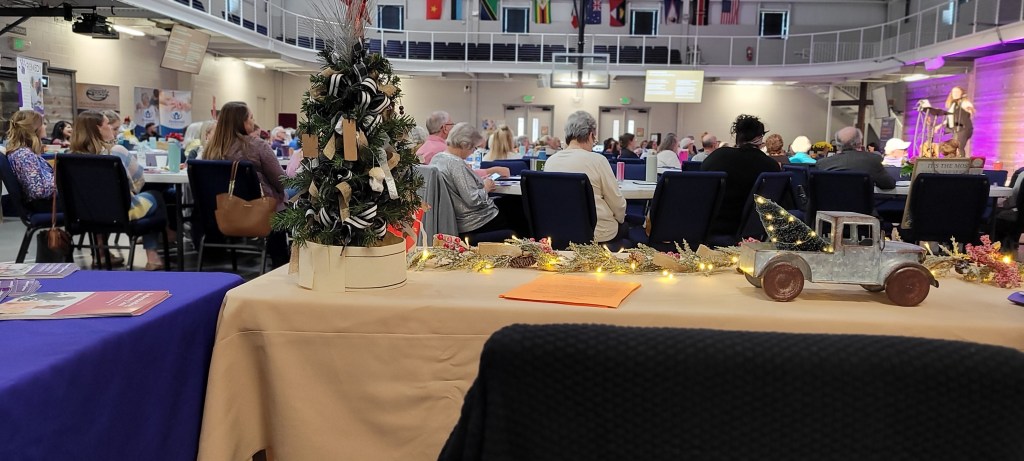
It was an honor to spend the day with every day heroes last week. I work with a group that hosts an annual symposium for Alzheimer’s and Related Disorders caregivers. This group includes amazing home caregivers and workers in the field who come to earn continuing education units. This photo was taken during a presentation on music therapy.
My assigned task at registration and check in is with the actual home caregivers. This is where I make new friends and hug old ones. Some walk in looking exhausted and needing a break from caregiving. Others walk in as couples and it is evident that one is the other’s caregiver. Siblings come in together to learn and support each other.
Our goal is for all to learn new information and leave encouraged. Our amazing volunteers and sponsors make homemade cinnamon rolls, provide lunch, set-up and break down, donate beautiful floral centerpieces and love on those who attend. Each vendor provides great door prizes for the caregivers.
A knowledgable caregiver is a better caregiver. I call them every day heroes because they give their all each and every day. My heart breaks when they are overwhelmed with little support. Many have given up income to be a caregiver. Many sacrifice finances to hire help. All are on duty 24 hours a day.
When these heroes complain, they almost always tear up and apologize. Guilt of not doing better weighs heavy on their shoulders. Many have expressed at the support group I lead that they feel ill equipped as a caregiver. They truly want to be amazing at what they do. One was battling with cancer while being a caregiver. Another walked in and announced she had suffered a mild heart attack. The group has bonded through sharing their stories and encouraging each other.
Are you one of these heroes I love so much? Do you have a support group to build you up and encourage you? I encourage you to seek one out. Perhaps your church would sponsor a day for caregivers.
If I could be with you I would share a cup of coffee or hot tea and then send you off for a nap while I became the caregiver for a couple of hours. Since I can’t be everywhere for everyone I pray that God will send a friend or family member to do this for you.
So do not fear, for I am with you; do not be dismayed, for I am your God. I will strengthen you and help you; I will uphold you with my righteous right hand.
Song for Today
Prayer for Today
Dear God,
Lead me as I lead those around me. They now need me more than ever before. Show me how to connect with them so that they feel my love as well as yours. Thank you for the wisdom and grace you have given me as I serve as a caregiver to someone I hold dear.
The cicadian rhythm is the name of your body’s internal clock. Most of us know that it tells our body when to sleep and when to wake up. Many things can effect our circadian rhythm such as daylight savings time, food intake, stress, travel, night shift jobs and mental health condition. You know how you feel with jet lag or on the morning after daylight time changes. Everything seems sluggish and a little off for the normal person. Someone with declining cognitive abilities feels it in an amplified way.
According to the Cleveland Clinic your body sets your circadian rhythm naturally, guided by your brain. If your brain is impaired, then you can expect a little bit of turbulance in your circadian rhythm and you can expect unusual behavior.
Since we will be setting our clocks back an hour in November, you should be prepared for behavior changes such as listed below.
Restlessness
Pacing
Sundowning
Jumpiness
Irritability
Repetitive mannerisms and questions
Wandering
Hoarding
Sleep disturbances
Sleeping more during the day
In the fall as we have fewer daylight hours, take advantage of being in the sunlight as much as possible. Turning the home lights on and closing the blinds in the late afternoon may help with sundowning. This allows a transition from day to night with a little control.
Alzheimer’s causes sleep changes. These suggestions may help with those. Play soothing music during dinner. Try to relax and spend time doing quiet activities as bedtime approaches. Keep a bedtime schedule and routine. Treat any pain. Keep the bedroom temperatue comfortable.
Next week may be difficult due to trick or treaters so if possibe protect the person with dementia from scary scenes. They may have difficulty distinguishing real from costumes. You have the time change the same weekend. Plan ahead to make it easier on you and the one you care for.
Word for Today
“Come to me, all you who are weary and burdened, and I will give you rest. 29 Take my yoke upon you and learn from me, for I am gentle and humble in heart, and you will find rest for your souls. Matthew 11:28-29
Song for Today
Prayer for Today
Dear God,
I thank you for always being there for me. I don’t always know what to do or say as a caregiver but you know my heart. You know the pain and see me struggle. Give me peace so that I can rest when I lay my head down tonight.
Parkinson’s dementia is closely related to Lewy Bodies dementia.
Studies have found LBD and Parkinson’s disease may be linked to the same underlying abnormalities in the brain processing of alpha-synuclein. LBD and Parkinson’s disease dementia are similar except for the order in which the symptoms develop.
The timing of when symptoms occur may determine which diagnosis a person receives. If thinking problems appear within a year of movement difficulties, doctors diagnose Lewy body dementia. If dementia develops a year or more after Parkinson’s disease symptoms begin, doctors diagnose Parkinson’s disease dementia.
Common symptoms of Parkinsons with dementia include:
Sofly spoken muffled speech
Misnaming objects
Trouble understanding complex sentences
Difficulty focusing
Memory loss
Confusion
Moodiness
Change in appetite
Delusions
Change in energy level
Sleep disturbances ( vivid dreams)
Vision issues like difficulty spotting objects in a cluttered space.
Trouble planning and staying on task
Language challenges
This list may be alarming at first. Remember that changes occur over time. Always remember that the person is not acting out; however, the disease is. Here are ideas to assist in caring for someone with these behaviors
establish and follow a routine when possible
being extra comforting and patient
limiting distractions and avoid crowds
try to maintain a consistent sleep schedule
declutter your living space
learn all you can about Parkinsons dementia
Join a support group
Keep a journal of behavior changes, dels]usions, nighttime disturbances, etc. This will help you when speaking with physicians. Log all medication changes as well.
I know a family dealing with this dementia and have watched them make adjustments. Their family members have had police show up in the night because he called and reported someone had broken into their home. Now, he has taken to roaming around partially clothed. Recently he heard my voice as someone was listening to me speak on a recording. He told them that sounded like someone I know. He then tried to remember my name but could only come up with my husband’s name. He referred to me as his person.
Be calm. Be patient. Allow them to try to communicate and try to interpret what they are trying to say. As far as the police calls, most law enforcement departments now have a data base that contains information you provide alerting them that a family member at your address has dementia. This can allow them to have a mental health officer available. For the other issue, just close your blinds.
Take a deep breath. You can do this. When things become difficult, step away for a few minutes and try a new approach. If you read through previous posts you will find other helpful information. Many of the behaviors and symptoms are similar with all forms of dementia.
Be strong and take heart, all you who hope in the Lord.
Song for Today
Prayer for Today
Dear God,
Thank you for being faithful. There are days I feel like the battle will not end. On those days that I struggle to stand on hope, hold me as I wait on you to move on my behalf. You are the only thing I have that is always true. Help me to be able to say “It is well with my soul”.
Did you think I was addressing almost everyone who has earbuds in or maybe teens with messy rooms? Oh, it could be applied so easily to these. My husband listens to podcast while working on our farm. He walks into the house and ignores me because he forgets to turn the podcast off. Nothing is more frustrated than feeling unheard.
When a person has Alzheimer’s disease they can still hear. It takes their mind longer to process the information. When speaking with them you should slow your speech down. Use simple language with words that are easier to understand. In a conversation wait and let them attempt to reply to you.
This will take an effort on your part to restrain yourself from moving at the pace you are used to. Many of us are already thinking of our response when someone else is speaking. Perhaps, having to break that habit will help us become better listeners. The person you are now communicating with deserves your full attention.
Spouses are guilty of answering for their husband or wife when with others. This is their attempt to protect their spouse from embarassment. It becomes second nature. It happens especially when other family members are around. That is why children are shocked when they finally realize their parent has mild cognitive impairment. Often a caregiver passes away first and the children scramble making decisions about the other parent’s care. They got blind sided because the disease had been hidden so well.
Pay attention when you sense the smallest mental decline. Take the parent you are concerned about out for a walk or drive and pay close attention to their communication with you.
It is a wonderful gift that hearing is not the first sense to go with Alzheimer’s because music becomes an amazing tool. Please watch this video clip. It shows you what words have a hard time explaining. Grab a tissue.
Music can be extremely effective with people who have Alzheimer’s. Choose the music you use carefully. Remember to use their preferred songs and artists. Make selections from decades ago. My mom was nonverbal. I taught my granddaughter a song that mom had listened to as a teenager. When my granddaughter got to the chorus my mom said a few syllables while smiling. We had a breakthrough and they connected. I will always cherish that memory.
Many pianist still have muscle memory and can sit down and play. While volunteering in a memory care unit one day, I heard hymns coming from a baby grand piano. I turned to see one of the residents playing with total contentment on her face. The director of the facility informed me that her husband moved their piano there when she moved in.
Loud noises will startle someone with dementia. It is absolutely vital for you to stay in the hospital room when the patient has dementia. Constant voices in the hall, staff going in and out, beeping machinery, and sirens outside create fear and only add to the confusion of being in a strange place. Your touch and voice can be reassuring.
They are always listening. Do not talk about them and their condition in their presence. Show respect and honor them. Never ask them a do you remember question. Instead, you could say I loved our vacations with the children to the beach. We had long strolls as the sunset and collectied seashells. The seagulls surrounded us when the kids threw them snacks. Just hearing the story may spark a memory in them. They may then join in the conversation. Taking a photo to share while you recall the memory would be nice.
Even when they tire and their eyes close, they may be listening. Just the sound of your voice brings comfort. Talk about football, dancing or whatever topic they once enjoyed discussing.
When giving directions keep it simple.
Wrong Way –
We are going for a walk. Put your socks and shoes on then, grab a jacket from the closet.
Right Way –
Here are your shoes and socks. Put your socks on. Now put your shoes on. Let me help you get a jacket because it is cold outside.
When you ask them to make a choice keep it simple.
Wrong Way –
What doe you want to wear today?
Right Way –
Would like to wear the blue shirt or the red shirt?
Keep in mind that mutiple auditory inputs at once definitely become noise pollution. You may be able to hear two conversations at once, but they just hear lots of noise and struggle to keep up. Avoid crowds and parties when this becomes an issue. Each day is a struggle in processing all they hear. They get exhausted. Be patient.
But the seed on good soil stands for those with a noble and good heart, who hear the word, retain it, and by persevering produce a crop.
Song for Today
Prayer for Today
Dear God,
I praise you for giving us the gift of music. Help us to use it to brighten the lives of our family member with dementia. Help us to create moments for them that produces joy and they still feel vibrant and alive.
Communication has changed drastically and we still have not developed the skills to use it with effectiveness.
When I was younger we had a home phone that was on a party live. Due to limited resources in rural areas , Bell Southprovide service that connected several homes. Each family was assigned a certain ring. If anyone on the party line was talking, it prevented anyone else from using the line. Then any neighbors on your party line could ease their phone off the hook and ease drop. Gossip spread fast.
Prior to having our own line, my high school sweetheart, who later became my husband, would call and call only to get a busy signal for hours sometimes. When he finally was able to reach me, he would often detect someone picking up and listening. He would usually make weird remarks until they hung up. As I stated earlier, you have so many of avenues of communication now that my party line sounds like an extinct dinosaur. I gladly adjusted to new technology and appreciate the convenience.
This week I recieved a text with an evite attached. A cousin had sent it and asked me to send it to others for her. My phone then started getting texts with questions about the event. My thoughts were, “Hmm, I sent the evite as asked, but obviously no one paid close attention as they scanned one of their large number of text that day.” Had they carefully read the evite they would see I was just the messenger and not the host that could answer their questions.
People have so much communication flowing today that they often miss important details. Can you imagine how full the skies would be if everyone used a carrier pigeon for every text, call, facetime sessions and emails? Oh, I forgot to include instagram, tiktok and others.
Effective communication takes thought. Way too often, we fire off a quick text that gets taken the wrong way. The most effective communication is looking into someone’s eyes and watching their facial expressions. Men can be read easier if you know what to look for. A smile accompanied by tightened jaw muscles betrays their true feelings. Caregivers learn to calm themselves before talking to someone with dementia. We should practice this same hesitation and take time to phrase requests for help in a way that will be recieved correctly.
Caregivers find it neccessary to send invitations to join their caregiving party when overwhelmed. This invitation might be ignored. It might offend someone. It might lack the appeal to tempt some to accept. What would you even say? Let’s give it a try.
Dear Family Who Are Too Busy Too Care,
I am drowning over here. The dishes are piled in the sink. Laundry sits in baskets waiting to be done. The grass needs mowing. Mom has hidden my keys and her glasses today. She has 2 doctor appointments next week. We are nearly out of groceries and I am exhausted.
Would you like to drop by some day to help?
Wrong approach! Do not expect help from this invitation. This approach will not work. Expect criticism on your ability to handle things. Expect judgment about your complaining and whining. When communicating with family and friends, remember you will have to take a deep breath and carefully choose your words. Don’t just hint that you need help. When hints aren’t effective you will end up frustrated. Stating that you need help can make you feel guilty. It is hard to admit that you are struggling. It is hard for family to not get defensive because they feel guilty for not helping more.
After praying for wisdom and seeking God to prepare hearts, attempt an honest conversation with the person you are asking to help. Tell them your concerns and ask for possible solutions. Try something like this.
“Jane, mom has a cadiology appointment next Tuesday at 2 pm. My car needs an oil change and I really would like to get my hair cut. Could you please take mom for me? Even better, I will take mom and let you come for a visit on Friday from 1-4. She would love singing with you and I could schedule a haircut, get the oil changed and bring dinner home for all of us to enjoy. Which might work best for you?
It is alright to share that you are exhausted. Explaining the changes in behavior you are dealing with and a lack of sleep due to your loved one roaming at night might help your family have a clearer understanding of how difficult caregiving is.
Communication is vital for families who have someone with dementia. Find time to meet together. The quote below sums up effective communication.
“You can talk with someone for years, everyday, and still, it won’t mean as much as what you can have when you sit in front of someone, not saying a word, yet you feel that person with your heart, you feel like you have known the person for forever…. connections are made with the heart, not the tongue.” ― C. JoyBell C.
Take a break. Make a list of things you need help with. Decide who can help you. Carefully word your request and doing it over a cup of coffee may help. Choose your timing.
I know you are the one overloaded and should not have to make the request. I have been in your shoes. Don’t hold a grudge against others for not just seeing your need and offering their assistance without the ask. Everyone is wired differently.
Be blessed and pray for God to order the steps of others to come your way. Your most important communication will always be with God.
Word for Today
Moses had been given the task of being a leader over a nation of many. You have been given the task of leading someone on the path of Alzheimer’s and God’s words spoken to Mose can be applied to you.
Exodus 4:12 “Now go; I will help you speak and will teach you what to say.”
Song for Today
Prayer for Today
Dear Heavenly Father,
Here I am again feeling frustrated and exhausted. Forgive me for getting angry and hurt when family and friends abandon me in the task of caregiving. Teach me how to ask for their help. Prepare their hearts to hear my request. Let my communication be spoken with love and not sound like whining and complaining.
When I began this blog, I was in the midst of an incredible journey that tested me like no other. The winds blew in storms as I stood on shifting sand. The lightning strikes had names such as Alzheimer’s Disease, vascular dementia and cancer. Thunder rumbled in the distance whispering “this is more than you can bear”. A choice had to be made. I couldn’t control the storm, but I could change my reaction.
The storms finally abated leaving emptiness as I tried to process the heart wrenching pain.
You have walked with me as I shared part of my story. Most of it will only be known by my wonderful husband and closet friends. I have been open and honest. Writing has allowed me to work through grief and consider how all of the shifting sand made me stronger.
I stepped away from writing for a bit to enjoy life again. My decisions of what to do will be shared later in this post.
On our farm spring is a busy season. Nineteen acres abounds with wild blackberries, privet, weeds, fireants, snakes and opportunities to transform that chaos into lovely raised beds full of chard, lettuce, carrots, kale, herbs and garlic. We even used the chain saw and rediscovered our overgrown barn on the far corner near the woods.
The labor has been intense, but we know how rewarding it will be to enjoy the fruits of our labor. Only one grocey store sells chard. Can you believe even the farmers market doesn’t sell it? I am truly a southern girl, however my palette for greens is not limited to turnip greens and lettuce. I even saute lambs quarters and throw dandelions into salads.
A trip to the bay was enjoyed immensely. We set crab traps, fished and watched dolphins. On a whim, we stayed an extra week. It felt amazing not having to find someone to be on call if a parent had an emergency. That freedom helped me realize my role as caregiver had truly limited vacations and travel. Guilt tried to creep in as I reflected over the peace I now have. The tides have shifted and I am content knowing I have no regrets over the caregiving years.
As a seasoned caregiver, I can assure you that your hard work as a caregiver will be rewarded by small moments such as a shared laugh or hug when you know you have connected. I can assure you that you will survive. I can assure you that God walks with you. I can assure that life will change as you move on.
I am better equipped to offer encouragement, advice, comfort and education to others on the path of caregiving because of what I have experienced first hand. I have spent sleepless nights struggling with decisions or answering phone calls in the wee hours of the morning. I have answered the same question over and over and over again. I have watched a loved one cry out in pain when they can no longer tell you where they hurt. I have cried so many tears that I was numb by the time God called my parents, in-laws and cherished aunts and uncles home. I have been punched, hit and cursed at by a disease that robbed me of a loving parent. I get the demands and challenges you face.
My next adventure is beginning. I will be renaming this blog and will let you know when this happens. A pod cast featuring guests is in the beginning stages and two book ideas are in my head waiting to be on paper. I will continue to lead a local support group and am considering a google meet support group. This is the way my loved ones will live on in my heart and be honored. They instilled a faith in God in me and modeled a life of compassion, generousity, resilence and love that I now want to share.
I hope that each of you realize that you are amazing. You are able to meet the demands of caregiving. You didn’t seek this job. No one would. You aren’t perfect. Neither am I. Together we can encourage each other.
It is with excitement that I ask you to join me on my new adventures. You could be my guest as the podcast launches. You may want to join the google meet group. Leave comments if you would like to be a part of these.
In peace I will lie down and sleep, for you alone, Lord, make me dwell in safety.
Song for Today
Prayer for Today
Dear God,
I come to you with a grateful heart. You walked with me each moment as a caregiver. You spoke into my heart in the darkest moments when I felt helpless and afraid. I ask now that you do the same for caregivers aroound me. Reassure them that you have equipped them for the task. Let peace reign in their hearts and home.
While working on building projects with my husband, I learned the importance of fine tuning as we go. Measure twice and cut once. Check for levelness and squareness. Hold your breath when trimming with paint. Wear your grubby clothes. Use a drop cloth. Have a shop vac handy. Having the right tools is also vital. Hand planers, levels and safety glasses are always nearby for when we need them. The finished product is well worth the effort and time spent. You watched a plan come together and smiled at the finished product.
If only caregiving worked the same way! You can plan, carry out the plan and then find there is no fine tuning that can make life turn out as you thought it should. You cannot just sand off the edges when raw emotions erupt into anger and frustration. The breakfast you lovingly prepared because your spouse seemed to enjoy it immensely yesterday is pushed aside and they refuse to eat. You shopped for a few new shirts and your husband refuses to wear anything except the one he has worn for three days.
I found a book from my senior year of high schoool. The five year plan I set for myself was to go to college and get married. I check that one off. The ten year plan was to buy a house and have children. Check again! Then life happened fast and furious. Before I knew it the kids were off to college and our nest was empty.
We had a flurry of weddings and grandchildren. All was going according to what I had expected. Then I noticed my mom just wasn’t herself. My heart was gripped with the words Alzhiemer’s Disease. Caregiving was not in my plan for many years down the road. I couldn’t push the schedule back. Adjustments had to be made quickly. For the early years of the caregiving journey, frequent visits, prepping meals for the freezer to help dad, taking care of doctor visits, monitoring finances online and hiring help for my parents worked.
My time was being split between my parent’s home 6 hours from mine and my own home. Trips to visit grandchildren became less frequent. We made a couple of major adjustments. We moved near our grandchildren and my husband was able to work from home and travel with me. This cut my trip to 3 1/2 hours each way.
In the end, my parents were both declining. I moved them to an assisted living and nursing home close to me. Visits were then daily. My mom was in end stage with Alzheimer’s and my dad struggled with mini strokes, diabetes and incontinence.
I know that I never had to provide full 24 hour care like many of you do every day. I do know my mind was always questioning things. Did I give my husband enough time? What am I missing out on with my children and grandchildren? Did I leave food prepared and clothes washed for my husband and my parents? How many more hours do I have to fight traffic? When is the next doctor’s appointment? It felt like I was on one of those round spinning wheels we used to play on as a child. I had run around and around and then hopped on to ride. Grasping tightly to the metal bar, I held on so I wouldn’t fall off.
In the midst of my trying to plan for whatever happened, I came to realize I could not plan for all of the twist and turns ahead. I had to trust God with the plan. I had to let Him fine tune and adjust me for things to work. He then held me tightly so the ride of life would not throw me off.
Some of you have feelings of guilt and inadequacies. Recently I read another blog for caregivers. A caregiver felt like a failure. When asked why, her response will make you smile. She failed to give her husband a daily bath. Wow! I consider one every third day a success. You make great plans, but life as a caergiver shows you they don’t always work. Continue to plan but have several backup plans as well. Trust God to guide you and hold you tight.
For I know the plans I have for you,” declares the Lord, “plans to prosper you and not to harm you, plans to give you hope and a future.
Song for Today
Prayer for Today
Dear God,
I humble myself and ask for you to move the mountains that I cannot move. I will rest in your arms and let you hold me close while I witness your work in my situations.






















 Walking Them Home